
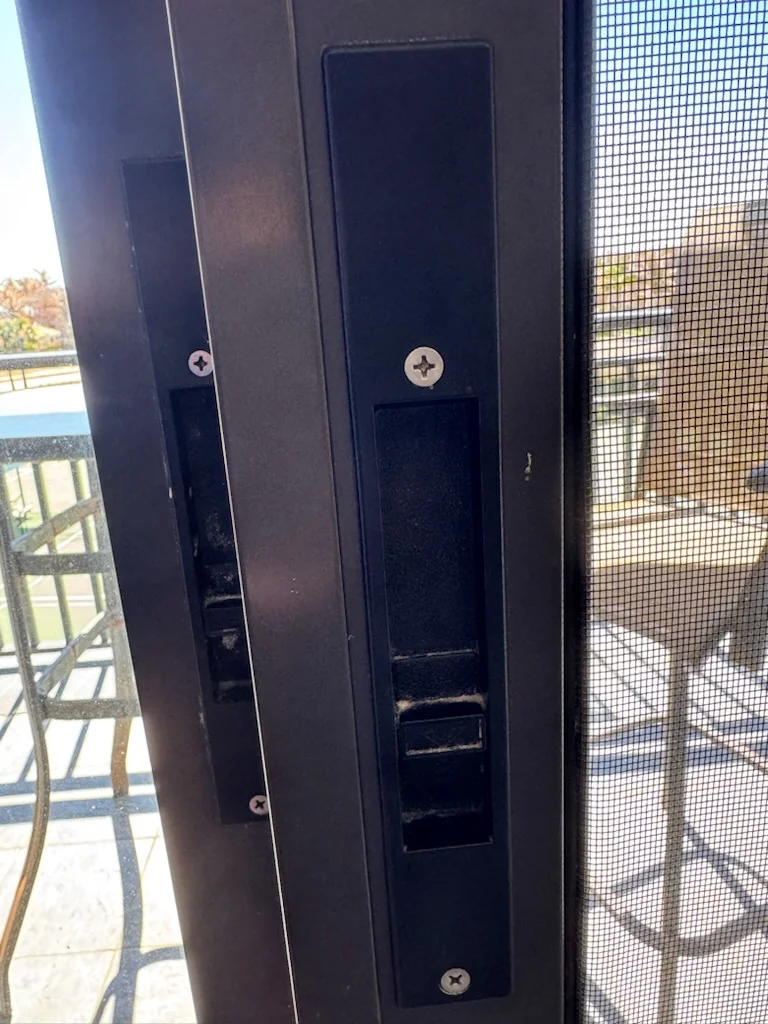
Sliding door locks are a latch in the panel and a keeper on the frame
Most sliding doors lock with a mortise lock: a narrow lock body set inside the vertical edge of the panel. When you turn the thumb latch, a hook swings out and catches a keeper, a metal strike fastened to the jamb. Some doors use two hooks or a lock that engages at several points. Older doors may have a surface mounted latch on the face of the panel instead. The handle set, the pull on the inside and the outside, is usually separate from the lock and is held on with through screws.
The parts fail in a handful of ways:
- The hook misses the keeper. When the panel sags on worn rollers or the keeper shifts, the hook hits above or below its target.
- Worn or broken springs. The latch flops, will not stay locked, or will not throw at all.
- Corroded lock bodies. Salt and moisture seize the small parts inside, and the thumb latch becomes stiff or stops.
- Cracked handles. Many handles are cast metal or plastic and crack at the screw bosses after years of pulling a heavy panel.
- Stripped screws. Handles work loose when their screws strip out of the panel.
The first test is whether the hook meets the keeper
Diagnosis separates alignment from hardware:
- Test with the door open. Turn the thumb latch with the panel away from the jamb. If the hook swings out and back cleanly, the lock works.
- Close slowly and watch. Slide the door shut and look at where the hook meets the keeper. If it hits high or low, the panel height or the keeper position is the problem.
- Check the gaps. A gap to the jamb that is wider at the top or bottom means a dropped corner, which is a roller issue.
- Identify the hardware. If the lock itself has failed, the body is measured: its length and width, the position of the hook, the distance from the edge, and the spacing of the handle screw holes. Locks and handles vary widely, and these measurements decide what will fit.
You can do the first three checks yourself. If the lock works with the door open but will not catch when closed, tell the technician; it narrows the problem down before the visit.
Replacing a lock or handle, step by step
- Remove the handles. The through screws are taken out and the interior and exterior pulls come off.
- Remove the lock body. The mortise lock is unscrewed from the panel edge and slid out of its pocket. Corroded screws may have to be drilled.
- Match the replacement. The new lock has to match the pocket size, the hook position and the handle hole spacing, or it will not work with the existing keeper and handles.
- Install and connect. The new lock goes in, and the handles are fitted so the thumb latch drives the lock fully.
- Align the keeper. The keeper on the jamb is adjusted so the hook catches without forcing. If the panel has dropped, the rollers are adjusted first.
- Test from both sides. The door is locked and unlocked several times, from inside and, on keyed locks, from outside, and pulled to confirm the hook holds.
Repair the alignment first, replace hardware only when it has failed
Adjusting the panel or the keeper is the right repair when the lock works with the door open. A new lock in a door that has dropped will not catch either. Replace the lock when the latch is broken, seized or loose inside, and replace the handles when they are cracked or the screw holes are stripped beyond repair.
The whole door is worth reconsidering only when matching hardware can no longer be found, or when the lock problem is one of several failures such as corroded tracks and fogged glass. See patio door installation for that case.
Many homeowners also add security at the same visit. Common options are an auxiliary lock at the bottom of the panel, a bar that blocks the track, and anti lift blocks or screws in the head track that stop the panel from being lifted out of its frame. More options are compared in sliding door security upgrades.
Florida salt air and hurricane rules affect sliding door hardware
Lock bodies are full of small springs and levers, and in coastal Florida salt air and humidity reach them through the keyway and the latch opening. Hardware near the beach or on a high rise balcony tends to stiffen and seize sooner than hardware inland. Stainless or coated parts, and keeping the hardware clean, help.
The lock also matters for storms. In a summer squall or a hurricane, a door that is not fully latched rattles and lets wind driven rain past its seals. In Miami-Dade and Broward, the High Velocity Hurricane Zone (HVHZ), every door carries an approval for that zone. The locking hardware is part of the door as it was tested, so on an approved impact door, replacement hardware should match the original design.
In a condominium, the door may be the owner's to maintain, but many buildings have rules for contractors such as work hours and elevator booking. Check with management before the visit.
Questions to ask before you approve lock or handle work
- Is the lock broken, or is the door out of alignment?
- Does the replacement lock match the pocket, the hook position and the handle holes?
- Will the keeper and the rollers be adjusted so the lock catches without force?
- On an impact door, does the replacement hardware match the door's original design?
- What is the total for parts and labor, confirmed before work starts?
For the most frequent causes, read why your sliding door will not lock, and see the service areas page for coverage.