
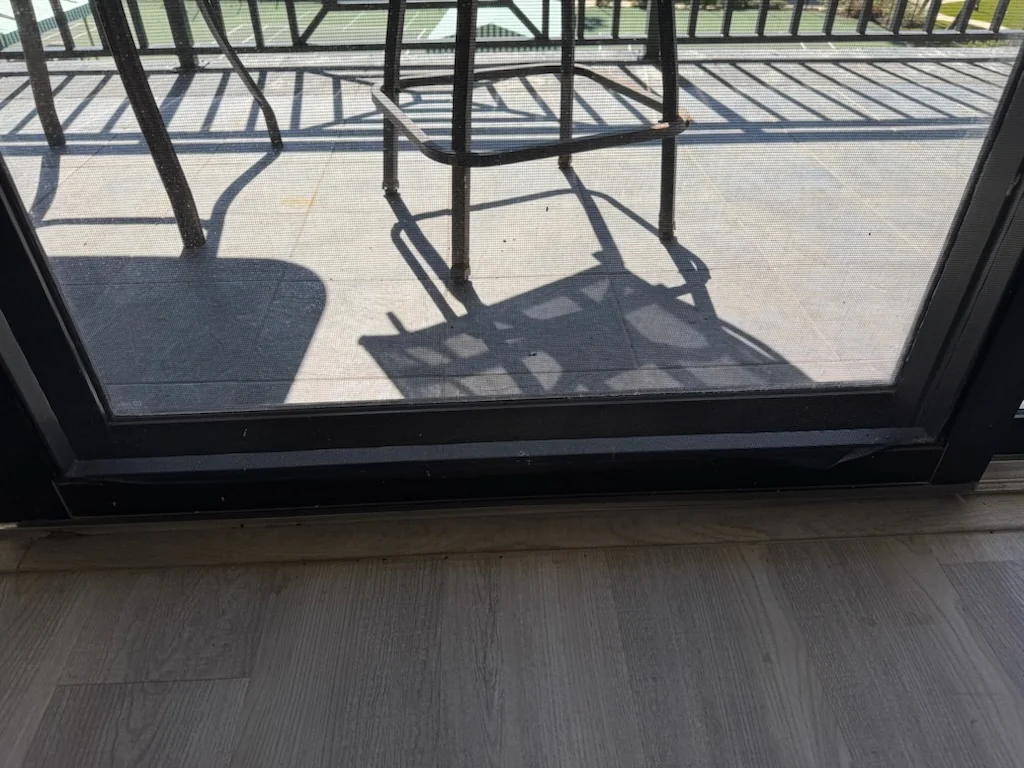
The track wears where the wheels ride, and salt makes it worse
A sliding door track is the bottom part of the frame, the sill. On most doors it is an aluminum extrusion with one or more raised rails, one for each sliding panel. The rollers ride on the crown of that rail, so all the weight of the panel bears on a strip a few millimeters wide.
That narrow strip is where the damage shows up:
- Pitting and corrosion. Salt and moisture attack the aluminum and leave small craters. Every pit is a bump the wheel has to climb.
- A flattened or grooved crown. A seized roller that slides instead of rolling grinds the rail into a flat or a groove.
- Dents and bends. Furniture, carts, dropped objects and storm debris can dent the rail or push it out of line.
- Packed debris. Sand, leaves and grit build up beside and on the rail and block the drainage.
- Loose or cracked sections. On some doors the rail is a separate piece held by screws, and the screws corrode or pull out.
A damaged track and worn rollers usually travel together, so the two are diagnosed as one system. See roller repair.
Checking a track starts with a clean rail and a straightedge
Most of the diagnosis can be seen once the track is clean. A careful check looks at:
- The rail surface. After vacuuming and wiping, a finger run along the crown finds pits, burrs and flat spots. A straightedge laid on the rail shows dips and bends.
- The drainage. Most sills have weep holes or slots that let rainwater out to the exterior. Water that sits in the track after rain usually means they are blocked.
- The fasteners and seal. Loose screws, a sill that moves underfoot, or gaps in the sealant where the sill meets the floor point to a bigger problem than the rail.
- The rollers. The panel is checked for seized or broken wheels, because they caused much of the damage and will damage a repaired rail too.
Before calling, you can vacuum the track, clear the weep holes gently with a soft wire or a pipe cleaner, and wipe the rail. If the door still catches in the same place, the rail itself is damaged.
Track repair runs from cleaning to a cap to a new sill
The repair is matched to the damage. In order of scope:
- Clean and dress. Debris and corrosion are removed and small burrs are smoothed so the crown is even. This is enough for light wear.
- Straighten. A minor dent can sometimes be worked back into line. Aluminum that has been bent hard may crack, so this only suits small damage.
- Cap the rail. A track cap is a formed channel, usually stainless steel, that fits over the existing aluminum rail and gives the wheels a new, smooth crown. The cap has to match the rail's shape and height, and the rollers have to match the cap. Because a cap raises the running surface slightly, the panel height is readjusted afterward.
- Replace a rail insert. On doors where the rail is a separate, replaceable piece, the insert can be changed without touching the frame.
- Replace the sill. When the sill is corroded through, cracked or no longer sealed to the floor, the sill or the whole frame has to be replaced. At that point a new door is often the more sensible project.
Most track jobs also mean lifting the panel out, so the rollers are replaced or adjusted at the same time and the door is tested over its full travel. For a deeper comparison, read track capping vs full track replacement.
A cap fixes the rail; a new door fixes a failed frame
Repairing or capping the rail is the right call when the damage is limited to the running surface and the sill is still solid, sealed and draining. That covers most tracks that are only pitted or grooved.
Repair is not enough when:
- the sill is corroded through or cracked, or water is getting under it into the floor or the wall;
- the frame is out of square, so the door cannot close evenly whatever the track looks like;
- the glass and the panels are also failing, and the door is near the end of its life.
In those cases compare patio door installation with the cost of repeated repairs.
Florida sills face salt, sand, wind driven rain and HVHZ rules
Florida is hard on tracks. Near the coast, salt settles in the sill and humidity keeps it wet, so aluminum corrodes year round. Sand from yards, pool decks and beaches collects beside the rail. In summer storms, wind driven rain is pushed against the door, and a sill only keeps it out if the weep system drains. A track packed with debris can let water back up and over the interior edge.
Two practical points follow. First, repair materials should not create new corrosion: dissimilar metals in contact in a wet, salty sill can corrode each other, so caps and fasteners should be chosen for use with the aluminum frame. Second, a door in Miami-Dade or Broward carries a High Velocity Hurricane Zone (HVHZ) product approval. The sill is part of the tested assembly, so a repair should not cut it, drill new holes through it or block its drainage. A rail cap that sits on top of the rail does not change the frame.
For more on how corrosion starts and how to slow it, read how salt air destroys sliding door tracks.
Questions to ask before you approve track work
- Is the damage only on the running surface, or is the sill itself failing?
- Will you cap, straighten or replace, and why that option for this rail?
- Does the cap match the rail profile, and will the rollers be matched to the cap?
- Will the weep holes be cleared and the drainage checked?
- Will anything be drilled or cut in the sill?
- What is the total, confirmed before work starts?
The service areas page shows the counties and cities covered.