
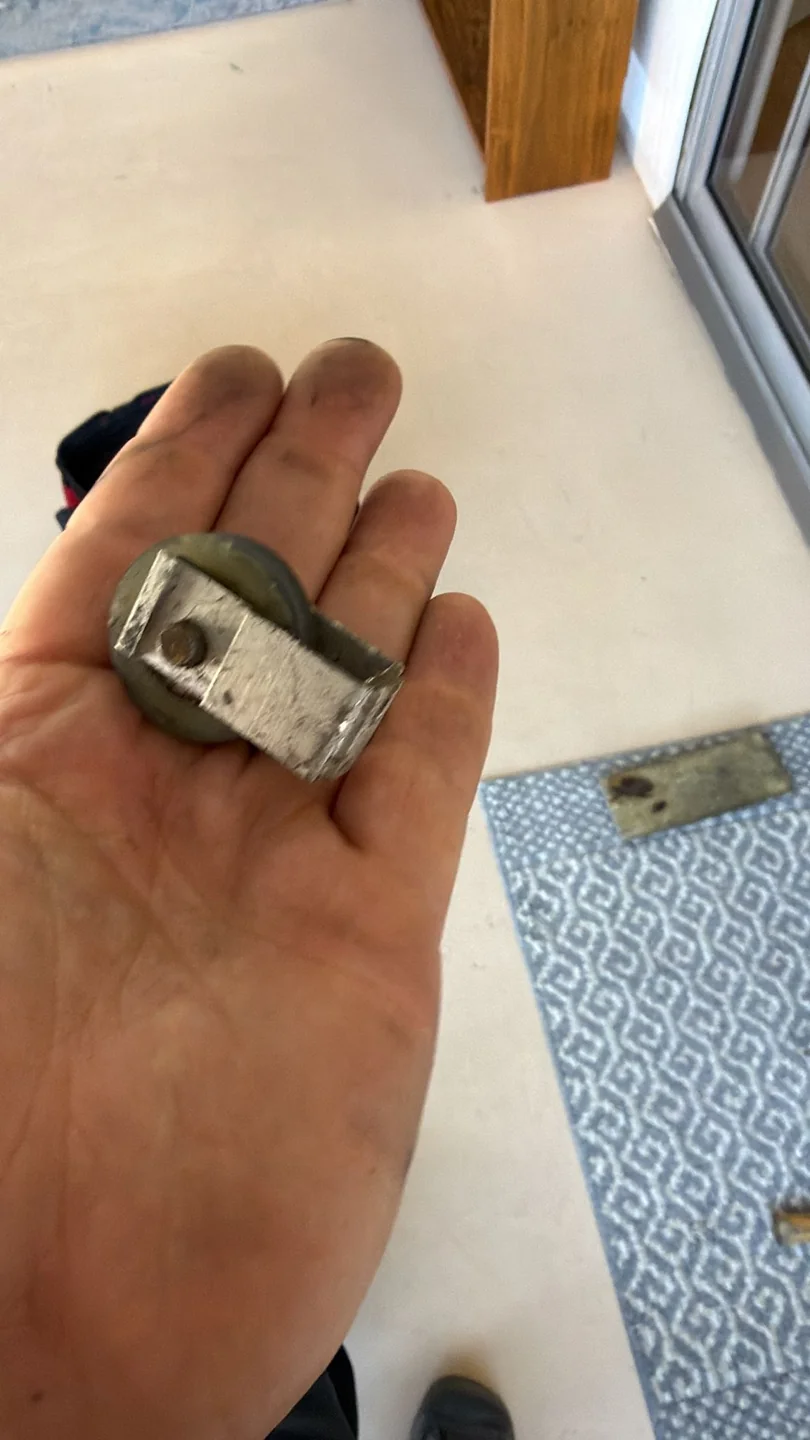
Rollers fail first because they carry the whole panel
A sliding door panel rides on two roller assemblies, one near each bottom corner, set into a channel in the bottom rail. Each assembly is a housing of steel, aluminum or plastic that holds one wheel or a pair of wheels in tandem, an axle or bearing, and an adjustment screw that raises or lowers that corner of the panel. The wheels ride on a raised rail in the sill track. Every time the door moves, those small wheels carry all of the glass and frame above them.
Rollers wear out in a few predictable ways:
- Worn or flat spotted wheels. Nylon and acetal wheels wear down, crack or develop flat spots, and the door starts to thump or rumble.
- Seized bearings. Once a bearing rusts or packs with grit, the wheel stops turning and slides instead. The door feels heavy and the rail gets gouged.
- Broken housings. Plastic housings crack with age and heat, and the wheel tilts or drops out of position.
- Lost adjustment. A screw that has backed off or corroded lets one corner sink, so the panel rubs the track or the frame.
Rollers rarely fail alone. A seized wheel scores the track, and a damaged track wears out new wheels quickly, which is why a sound roller job always includes a look at the sliding door track.
How a roller problem is told apart from a track or frame problem
The symptoms overlap, so diagnosis comes before parts. A careful check usually runs in this order:
- Watch and listen. Grinding or crunching points to a dry or seized bearing. A rhythmic thump points to a flat spot. A door that is smooth for most of its travel and catches in one place points to a dent or debris in the track.
- Check the gaps. With the door closed, the gap between the panel and the jamb should be even from top to bottom. A wedge shaped gap means one corner has dropped.
- Look at the rail. A rail with pits, a flattened crown or a bend will chew through any wheel.
- Try the adjustment. Most doors have adjustment screws behind small plugs or holes near the bottom of each end of the panel. If turning the screw raises the panel and the glide improves, the rollers may only need cleaning and adjustment. If the screw spins freely or nothing changes, the roller is usually broken.
- Check the lock. A dropped panel often keeps the latch from meeting the keeper on the jamb, so a door that will not lock may really have a roller problem.
You can do the first three checks yourself before calling. Vacuum the track first: a surprising number of stiff doors improve once packed sand is removed.
What a roller replacement involves, step by step
- Identify the roller. Rollers are not universal. The housing size, wheel diameter, wheel profile and adjustment style all have to match the door, so the old roller is measured or removed for matching.
- Lower the panel and lift it out. The adjustment screws are backed off so the panel sits as low as it can. On many doors the panel is then raised into the head track and the bottom swung out; on others a head stop or bracket has to come off first. Impact glass panels are heavy, and lifting one safely takes two people.
- Remove the old rollers. They usually slide out of the ends of the bottom rail once a retaining screw is removed. Corroded screws may have to be drilled out.
- Clean and inspect. Sand, debris and corrosion are cleared from the track, and the weep holes that drain the sill are opened so water can leave.
- Install the new rollers at an even starting height and set the panel back on the rail.
- Adjust and test. Both screws are turned until the panel is level, the gap to the jamb is even and the latch meets its keeper without force. The door should roll its full travel with light, even pressure.
New rollers fix the door only when the rest of it is sound
New rollers are the right repair when the panel, the glass and the frame are in good shape and the rail is smooth or can be repaired. Rollers are a small part of the door, so replacing them is far less work than replacing a door.
Rollers alone will not solve the problem when:
- the rail is pitted or flattened, so the track needs repair or a cap at the same visit;
- the bottom rail of the panel is corroded or cracked and the new rollers have nothing solid to sit in;
- the frame is out of square from settling or damage, so no roller height lets the door close evenly;
- the door uses rollers that can no longer be matched, which happens with some older and discontinued doors.
If the glass is fogged or cracked, or the door no longer suits the house, read when to replace instead of repair and compare glass replacement with a new patio door installation.
Salt air, sand and heavy impact glass shorten roller life in Florida
Three Florida conditions work against rollers. Salt air near the coast corrodes steel bearings and axles, and humidity keeps surfaces from drying out, so the corrosion keeps going. Fine sand blows into the sill track and grinds inside the bearings. And impact resistant sliding doors, common in Miami-Dade and Broward because those two counties form the High Velocity Hurricane Zone (HVHZ) of the Florida Building Code, use laminated glass and heavier frames, so each roller carries more weight than it would on an older single pane door.
That has practical consequences. Rollers should be matched to the weight of the panel, not just the size of the slot. Stainless steel bearings hold up better near salt water than plain steel. And on a door that carries a product approval for the HVHZ (a Miami-Dade Notice of Acceptance or a Florida Product Approval), replacement parts should fit the original design so the panel keeps closing and sealing the way the door was tested. For more on wheel materials, see stainless vs nylon rollers.
Many condo buildings have their own rules for contractors, such as proof of insurance, work hours and elevator booking. Check with your management office before the visit is set.
Questions to ask before you approve roller work
- Is the problem the rollers, the track, the frame or a mix, and how did you tell?
- Are the replacement rollers matched to this door and to the weight of the panel?
- Will the track be cleaned and checked, and does it need repair at the same visit?
- What is the total for parts and labor, confirmed before work starts?
- Will the lock be checked and adjusted after the panel is reset?
Early warning signs are covered in 5 signs your rollers are about to fail, and the service areas page lists the counties and cities covered, including Broward and Miami-Dade.